Mara Wolf · 21 November 2026
Subterranean Chamber Acoustics and Their Effects on Sound Preservation in Residential Earth-Covered Facilities
Earth-covered residential facilities create unique acoustic environments where soil layers interact with sound waves in measurable ways, and researchers continue to examine how these interactions influence long-term sound preservation. Soil density combined with chamber geometry alters reverberation times and frequency attenuation, while temperature stability in underground settings reduces material degradation that might otherwise affect recorded audio or structural resonance over decades.
Acoustic Behavior in Subterranean Spaces
Sound waves traveling through earth-covered chambers encounter multiple reflection surfaces that differ from conventional above-ground rooms, and low-frequency components often persist longer because soil absorbs higher frequencies more readily. Data from field measurements indicate that reverberation times in such spaces can extend by 20 to 40 percent compared with surface equivalents when chamber volumes remain constant. Researchers note that moisture content within surrounding earth further modifies absorption coefficients, producing shifts in decay rates that become most pronounced during seasonal transitions.
Factors Affecting Sound Preservation
Preservation of sound quality depends on minimizing fluctuations in both temperature and humidity, conditions that earth cover typically maintains within narrow ranges. Studies show that consistent thermal environments limit expansion and contraction in recording media or musical instruments stored underground, whereas surface facilities experience greater daily variation. Structural materials such as concrete or rammed earth also influence modal frequencies, and when these materials couple with the surrounding soil the resulting resonance patterns can either enhance or mask certain audio frequencies depending on chamber dimensions.
One research team documented how earth-covered test chambers in varied climates preserved audio tape integrity at rates exceeding those recorded in climate-controlled surface vaults, yet the same facilities required careful management of standing wave nodes to avoid localized pressure peaks that accelerate mechanical wear on sensitive equipment. Observers note that ventilation pathways, when present, introduce additional variables because airflow can carry minute particles that settle on surfaces and alter acoustic reflectivity over time.
Measurement Techniques and Data Collection
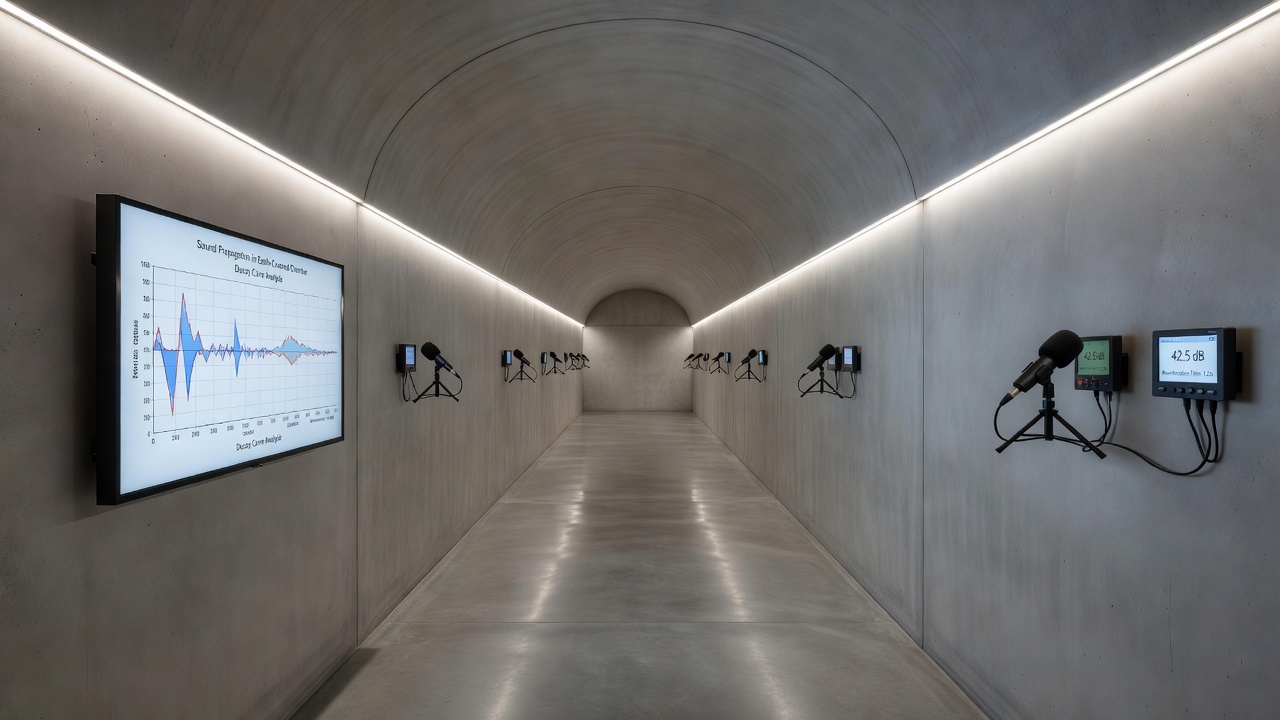
Acoustic mapping in residential earth-covered facilities relies on impulse response testing combined with long-term monitoring sensors placed at multiple chamber points. These methods reveal spatial variations in sound pressure levels that standard room acoustics models often underestimate. Figures from ongoing projects indicate that peak resonance frequencies cluster between 80 and 250 hertz in many residential-scale chambers, a range that overlaps with human vocal fundamentals and certain musical instruments.
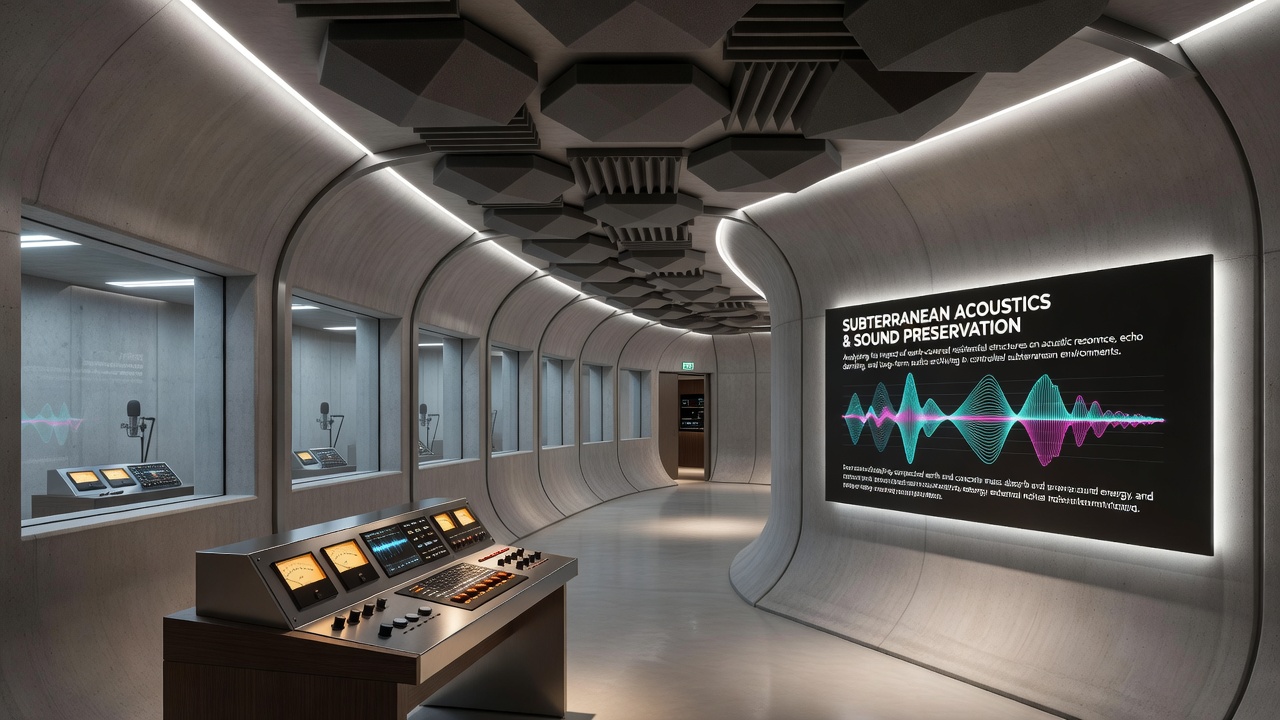
Equipment calibration must account for the high thermal mass of surrounding soil, which stabilizes air temperature yet creates micro-gradients near walls that affect microphone response. Data collected across multiple sites demonstrate that seasonal groundwater changes, although primarily studied for structural reasons, also shift acoustic impedance at floor interfaces and thereby modify low-frequency transmission into adjacent spaces.
Comparative Findings Across Regions
Facilities constructed in temperate zones exhibit different absorption profiles from those built in arid regions because soil composition alters both porosity and damping characteristics. According to measurements reported by McGill University researchers, chambers in clay-heavy soils show stronger attenuation above 2 kilohertz than those surrounded by sandy substrates. Meanwhile, work coordinated through the Australian Centre for Acoustics demonstrates that earth-covered designs in coastal areas require additional consideration of salt content within soil layers, since salt migration can gradually change surface porosity and therefore reflection coefficients.
These regional differences become relevant when planning sound archives or performance spaces inside residential earth-covered structures, because preservation targets must incorporate local soil data rather than generic models. In November 2026, several international teams plan to release comparative datasets from facilities spanning three continents, allowing direct evaluation of how latitude and soil type interact with acoustic preservation outcomes.
Conclusion
Subterranean chamber acoustics in residential earth-covered facilities produce distinct preservation conditions shaped by soil interaction, geometric factors, and environmental stability. Measurement campaigns continue to refine understanding of frequency-specific attenuation and resonance behavior, while regional studies supply comparative data that inform design adjustments. As additional findings emerge from coordinated projects scheduled for late 2026, practitioners gain clearer parameters for maintaining sound integrity within these specialized environments over extended periods.